
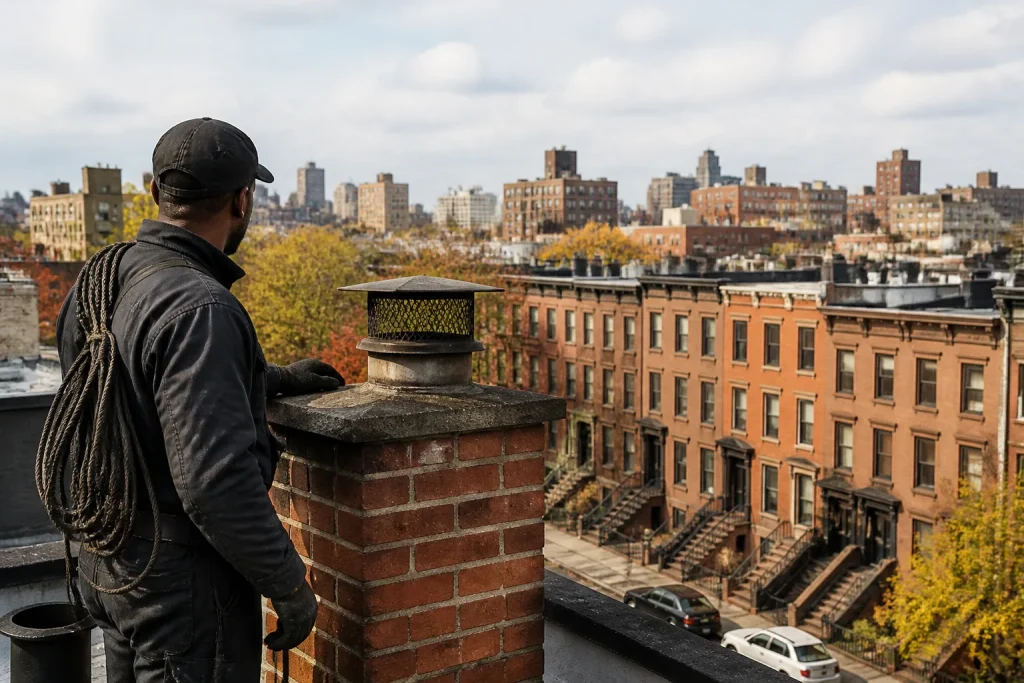
Chimney Sweep: Repair or Replace? How Harlem Homeowners Decide
Most Harlem chimneys don’t need to be rebuilt. They need the one component that’s actually failing to be diagnosed correctly, and then repaired with the right material. The decision to repair or replace comes down to which of three parts is compromised: the flue liner, the firebox interior, or the exterior masonry and crown. A sweep who recommends a full rebuild on a 90-year-old brownstone flue before running a camera scan is guessing, and a wrong guess costs real money. If you’d rather not sort that out yourself, call (833) 468-5664.
Why Age Alone Doesn’t Decide It
A brownstone chimney can be a century old and still be in perfectly serviceable shape. What matters is the condition of the individual parts, not the number of years on the brick. In Harlem’s brownstone and rowhouse stock, we regularly find flues that have held up well because they were built with a proper clay tile liner and never overheated, sitting right next to a chimney of the same era with tiles cracked from a single chimney fire nobody noticed.
The parts fail on their own timelines, and each has a different repair-or-replace threshold. That’s why a blanket answer doesn’t work:
- Flue liner: clay tile, cast-in-place, or metal insert. Often repairable, sometimes replaceable with a liner system rather than a rebuild.
- Firebox interior: prefab refractory panels in gas inserts, or full masonry in older wood-burning fireplaces. Usually repairable in place.
- Exterior structure: mortar joints, crown, and cap. Tuck-pointing and crown work are repairs. A leaning or bowing stack above the roofline is a different conversation.
Our technicians have up to 13 years of experience reading exactly this kind of layered diagnosis. It starts with an inspection, not an estimate for the biggest job on the menu.
Flue Liner: The Component That Decides Most Cases
When people ask whether a Harlem chimney should be repaired or replaced, the flue liner is usually what’s really being decided. Here’s how we weigh it:
- Cracked tiles with intact joints: a candidate for ceramic resurfacing. We use HeatShield, which reapplies a ceramic lining over the existing substrate. You keep your original flue geometry, and you don’t pay for a tear-out.
- Tiles missing or collapsed: resurfacing won’t bridge a gap where the tile is gone. That’s a stainless liner insert, sized to the appliance, and installed as a continuous flue.
- Flue offset beyond manufacturer specs: when the original flue was built with an offset greater than the liner system allows, a flexible liner is required regardless of tile condition. A straight rigid liner simply won’t make the turn. DuraFlex flexible liner is what we reach for here for exactly that reason.
A liner isn’t replaced for its own sake. It’s replaced when the existing flue can’t be brought back to safe function. Get a camera scan up the flue and look at the footage. You don’t have to understand every frame, but you should be able to see the crack the technician is pointing at.
Firebox Interior: Almost Always a Repair
Fireboxes fail in two ways, and both have a repair path that stops well short of a rebuild.
Prefab refractory panels in a gas insert are modular. A panel with a crack or spalled face can be replaced individually rather than rebuilding the firebox. This is a repair, and it’s the right call when the surrounding panels are sound.
Full masonry fireboxes with spalling brick are often repaired with a castable refractory material rather than torn out. A castable refractory rebuilds the firebox face and joints to a smooth, heat-rated surface while the original brickwork stays in place. That’s the difference between a targeted repair and a project that turns your living room into a construction zone.
The threshold for replacement on a firebox is structural: separated brick that can’t be tied back, or a firebox so far gone that no castable repair will hold. That’s rarer than the number of rebuild quotes would suggest.
Exterior Masonry, Crown, and Cap: Where Honesty Matters
The exterior is where a repair-or-replace answer gets uncomfortable, because it’s the one place full replacement is sometimes genuinely required. Here’s where we draw the line:
- Deteriorated mortar joints: tuck-pointing is a repair. Repointing the joints with the right mortar mix is standard masonry work, and it’s what keeps water from getting behind the brick.
- Cracked or porous crown: the crown is the concrete top that sheds water away from the chimney. When it fails, water goes into the masonry and into the flue. Rebuilding the crown is a repair. This is where chimney cap & crown work earns its keep.
- Missing or loose cap: the cap keeps rain, birds, and debris out of the flue. Fitting a proper cap is a repair, not a replacement.
- Leaning or bowing stack above the roofline: this is a replacement scenario. A chimney that’s visibly out of plumb needs structural assessment, not another sweep. Don’t let a cleaning crew talk you into repointing a stack that’s actually moving.
We handle the cap, crown, and structural chimney repair as part of the same relationship, which matters most when the diagnosis changes mid-job.
What Documentation You Should Demand Before Deciding
A repair-or-replace decision is only as good as the evidence behind it. Before you authorize anything at your chimney, ask for:
- A written inspection report. A Level 2 inspection report identifies the components inspected and the condition found. A verbal “it’s bad up there” isn’t documentation.
- Camera footage with timestamps. If the technician points at a crack, the video should show it, and the timestamp should match the report. You should be able to watch it.
- Material specifications for any proposed repair. If the fix is a ceramic resurfacing, you should know it’s HeatShield or an equivalent, not a generic patch. If it’s a liner, you should know the brand, the size, and why it fits your flue. Trade-grade materials like Olympia Chimney or Gelco components are named on the quote, not left vague.
- A compliance statement. The report should say whether the proposed work brings the system into NFPA 211 and local NYC code compliance. If it doesn’t say so, ask why.
You should also get a straight answer on any work that can safely wait. A crown that’s starting to crack but isn’t letting water in yet is a “schedule it” repair. A loose tile in a flue that’s actively venting a wood-burning fireplace is not. A responsible technician tells you the difference.
That’s the underlying difference between a diagnosis and a sales pitch. If a sweep recommends a full rebuild on a Harlem flue without a camera scan and a look at the tile substrate, they’re guessing. Full chimney rebuilds can run $8,000 – $15,000 in this market, and that guess is expensive when it’s wrong.
The Bottom Line
In most Harlem brownstones, the chimney is a candidate for targeted repair if the right materials and methods are used. The flue liner, the firebox, and the exterior structure fail independently, and each has its own threshold. The rare exceptions are a collapsed liner that can’t be bridged, a firebox that no castable refractory will hold, and a stack that’s leaning or bowing above the roofline.
The way to know which case you’re in is a Level 2 inspection with camera footage, a written report, named materials, and a compliance statement. If a technician can’t show you those, get a second opinion before you commit to a rebuild.
Here’s the practical version: get an inspection, look at the footage, and decide from what you can actually see. If you’re in Harlem and need help, Chimney Sweep Harlem offers free estimates – call (833) 468-5664. We answer 24/7, with fast dispatch from 7am to 7pm, Sunday through Friday.
Frequently Asked Questions
Repair the chimney if the flue liner, firebox, or crown has a specific, identifiable defect that can be restored to safe function with the right material. Replace only when a component is beyond repair: collapsed or missing liner tiles that can’t be spanned, a firebox that no castable refractory will hold, or a stack that’s leaning or bowing above the roofline. In Harlem brownstones, the repair case is far more common than the replace case. Call (833) 468-5664 for an inspection-based answer.
You know the liner needs to be replaced when tiles are missing or collapsed, or when the flue offset exceeds manufacturer specs and a flexible liner is required. Cracked tiles with intact joints are usually a candidate for ceramic resurfacing instead of a full liner replacement. The way to tell is a camera scan, not a guess from the roof. Call (833) 468-5664 to book one.
Yes, in most cases. Prefab refractory panels can be replaced individually, and full masonry fireboxes with spalling brick can be repaired with a castable refractory rather than torn out. Full rebuild is the rare exception, reserved for structural separation that can’t be tied back. Call (833) 468-5664 to find out which case you’re in.
A proper report should include a written Level 2 inspection, camera footage with timestamps that match the findings, material specifications for any proposed repair products, and a clear statement of whether the work brings your system into NFPA 211 and local NYC code compliance. If any of those are missing, ask before you sign. Call (833) 468-5664 if you want a second read on a report you’ve already received.
Written by the team at Chimney Sweep Harlem.
Need Chimney Cleaning Help?
Call Chimney Sweep Harlem - the local pro we connect you with is licensed and insured, here with fast help in Harlem.
(833) 468-5664